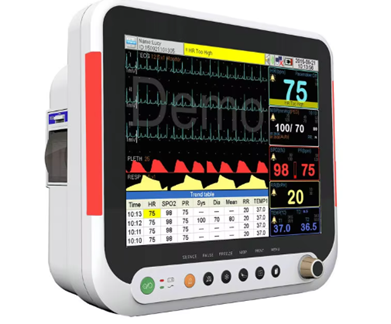
| Performance Specifications |
| Dimension and Weight |
Dimension |
393mm*382mm*173mm |
| Weight |
4.5kg(excluding accessories) |
| Power Supply |
Voltage / Power |
AC100~240V, 50/60HZ, Power≤60W |
| Display |
Screen |
15″ color TFT LED |
| Resolution |
1024*768 pixels |
| Battery (Pluggable) |
Type |
Rechargeable lithium battery 14.8V/2200mAh |
| Charge Cycle |
≥500 times |
| Working time |
2 hours (optional larger battery for 4-5 hours) |
| Recorder (Option) |
Method |
Thermal printer |
| Paper width |
50 mm (1.97 in) |
| Printing speed |
12.5/ 25/ 50 mm/s |
| Trace |
Max. 3 tracks |
| Recording way |
Real-time Recording, Review Printing, Periodic Recording, Alarm Recording |
| Alarm |
Level |
Low, medium and high |
| Indication |
Auditory and visual |
| Alarm volume |
Adjustable |
| Alarm pause time |
1min, 2min |
| Parameter alarm type |
Latch/ Unlatch |
| Input Device |
Knob |
Standard |
| Keypad input |
Standard |
| Mouse/ Keyboard input |
Option |
| System Output & Extensible Interface |
Ethernet Network |
1 standard RJ45 socket |
| USB Port |
1 |
| Video Output |
1 HDMI port (option) |
| Operating Environment |
Temperature |
5 ~ 40 ℃ |
| Humidity |
15% ~ 80% (non-condensing) |
| Atmosphere pressure |
86 KPa ~ 110 KPa |
| Transportation and Storage Environment |
Temperature |
-20~50 ℃ |
| Humidity |
10%~90% (non-condensing) |
| Atmosphere pressure |
86 KPa ~ 110 KPa |
| Safety |
IEC60601-1 Approved, CE marking according to MDD93/42/EEC. With reference to RoHS Directive 2011/65/EU recasting |
| Trend & Reviewing |
Trend |
2160 hours |
| ARR events |
128 groups of ARR events and associated waveform |
| NIBP measurement reviewing |
2000 groups |
| Waveform review |
2 hours |
| Alarm event |
2000 groups of parameter alarms events and associated parameter |
| ECG |
Lead mode |
3/5 Leads, I, II, III or I, II, III, AVR, AVL, AVF, V |
| Protection |
Breakdown Voltage 4000VAC 50/60Hz; Defibrillator proof |
| Gain |
2.5mm/mV (×0.25), 5.0mm/mV (×0.5), 10mm/mV (×1), 20mm/mV (×2), 40 mm/ mV (×4), Auto |
| Sweep speed |
6.25mm/s, 12.5mm/s, 25mm/s, 50mm/s |
| ECG signal range |
±12 mV (Gain × 0.25) |
| Accuracy |
±1bpm/ ±1%, whichever is greater |
| Resolution |
1 bpm |
| Leakage Current |
< 10μA |
| Baseline Recovery |
≤ 3s after defibrillation (Monitor mode) / ≤ 1s after defibrillation (Surgery mode) |
| Bandwidth |
Surgery 1 ~ 25 Hz / Monitor 0.5 ~ 40 Hz / Diagnostic 0.05 ~ 120 Hz |
| Indication of Electrode Separation |
Every electrode (exclusive of RL) |
| Heart Rate |
Measure range |
Adult: 0bpm; 10 ~ 300 bpm / Neo/Ped: 0bpm; 10 ~ 350 bpm |
| Resolution |
1 bpm |
| Accuracy |
± 1% or ± 1bpm, whichever is greater |
| ST Measurement |
Range |
-2.0 ~ +2.0 mV |
| Accuracy |
-0.8mV~+0.8mV: ±0.02mV or ±10%, whichever is greater |
| Other range |
Unspecified |
| Resolution |
0.01mV |
| Respiration |
Method |
Impedance between RA-LL, RA-LA |
| Gain |
×0.25, ×0.50, ×1, ×2, ×4 |
| Respiration Rate |
0bpm, 6 ~ 150 BrPM |
| Sweep speed |
6.25 mm/s, 12.5 mm/s, 25mm/s |
| Resolution |
1 BrPM |
| Accuracy |
±2 bpm or ±2%, whichever is greater |
| Apnea Alarm |
10 ~ 60 s |
| NIBP |
Method |
Oscillometric |
| Measure mode |
Manual, Auto, STAT |
| Measure Interval in AUTO Mode |
1~480 min |
| STAT mode cycle time |
Keep 5 minutes, at 5 seconds interval |
| Measure and Alarm Range – Adult |
SYS: 30 ~ 270 mmHg / DIA: 10 ~ 220 mmHg / MEAN: 20 ~ 235 mmHg |
| Measure and Alarm Range – Pediatric |
SYS: 40 ~ 235 mmHg / DIA: 10 ~ 220 mmHg / MEAN: 20 ~ 225 mmHg |
| Measure and Alarm Range – Neonate |
SYS: 30 ~ 135 mmHg / DIA: 10 ~ 110 mmHg / MEAN: 20 ~ 125 mmHg |
| Static pressure accuracy |
±3mmHg |
| Resolution / Accuracy |
1mmHg / Maximum Mean error ±5mmHg / Maximum Standard deviation ≤8mmHg |
| Over pressure Protection |
Dual protection via software & hardware |
| Temperature |
Technique |
Thermistor probe (2.25K) |
| Channel |
Dual-Channel, provide T1; T2; ΔT |
| Measuring and Alarm Range |
0.0 ℃~ 50 ℃ (32℉~ 122℉) |
| Unit |
Celsius (℃), Fahrenheit ( ℉) |
| Resolution |
0.1℃or 1℉ |
| Accuracy |
±0.1℃(exclusive probe) |
| SpO2 (Digital Technic) |
Measurement Range |
0 ~ 100 % |
| Resolution |
1 % |
| Response Modes |
Low, Medium, High |
| Accuracy |
±2% (70% ~ 100%) / ±3 % (35% ~ 69%) / Unspecified (0 ~ 34%) |
| Pulse Rate |
Measuring and Alarm Range |
25~250bpm |
| Accuracy |
±1% or ±1 bpm, whichever is greater |
| Resolution |
1bpm |
| Nellcor-SpO2 (Option) |
Measurement Range |
0 ~ 100 % |
| Resolution |
1 % |
| Accuracy |
70% ~ 100%, ±2 % (adult) / 70% ~ 100%, ±3 % (Neonate) / 70% ~ 100%, ±2 % (Low Perfusion) / 0% ~ 69%, unspecified |
| Pulse Rate – Measurement range |
20 ~ 300 bpm |
| Pulse Rate – Accuracy |
±3 bpm (20 ~ 250 bpm) / unspecified (251~300 bpm) |
| Masimo SpO2 (Option) |
Measurement Range |
0 ~ 100 % |
| Resolution |
1 % |
| Accuracy |
70% ~ 100%, ±2 % (adult/ pediatric, non-motion conditions) / 70% ~ 100%, ±3 % (neonate, non-motion conditions) / 70% ~ 100%, ±3 % (motion conditions) / 0% ~ 69% unspecified |
| Pulse Rate – Measurement range / Accuracy |
25 ~ 240 bpm / ±3 bpm (non-motion condition) |
| Resolution |
1bpm |
| EtCO2 (Mainstream/ Side-stream) (Option) |
Measure method |
Non-dispersive infrared (NDIR) |
| Measure Range |
0 ~19.7% (0 ~ 150 mmHg) / 0 ~ 20 kPa |
| Resolution |
0.1 mmHg |
| CO2 Accuracy |
0 ~ 40 mmHg, ±2 mmHg / 41 ~ 70 mmHg, ±5% of reading / 71 ~ 100 mmHg, ±8% of reading / 101~ 150 mmHg, ±10% of reading (at 760 mmHg, ambient temperature of 25℃) |
| Respiratory Rate |
Range: 3 ~150 BrPM / Accuracy: ±1 bpm |
| EtCO2 (Micro-stream) (Option) |
Measure method |
Non-dispersive infrared (NDIR) |
| Measure Range |
0 ~19.7% (0 ~150 mmHg) / 0 ~ 20 kPa |
| Sample Rate |
50 mL/min ±10mL/min |
| Resolution |
0.1 mmHg (0 ~ 50 mmHg) / 0.25 mmHg (50 ~ 114 mmHg) |
| CO2 Accuracy |
0 ~ 40 mmHg, ±2 mmHg / 41 ~ 70 mmHg, ±5% of reading / 71 ~ 100 mmHg, ±8% of reading / 101~ 150 mmHg, ±10% of reading (at 760 mmHg, ambient temperature of 35℃) |
| Respiratory Rate |
Range: 3 ~120 BrPM / Accuracy: ±1 bpm |
| Depth of Anesthesia (CSI) (Option) |
EEG sensitivity |
± 400μV |
| Noise |
< 2μVp-p, < 0.4μV RMS, 1-250 Hz |
| CMRR |
> 140 dB |
| Input impedance |
> 50Mohm |
| Sample rate |
2000 samples/sec, (14 bits equivalent) |
| BS% / EMG |
0-100, filter 1-42 Hz, 1 sec. display update / 0-100 Logarithmic. Filter 75-85 Hz, 1 sec. update |
| Alarms / Artifact rejection |
High / Low with user selectable limit / Automatic |
| Sensor impedance range |
0 – 10kOhm / measurement current 0.01μA |
| Multi-gas/O2 (Anesthetic Gas) (Option) |
Method |
Infrared absorption |
| Gas sorts |
CO2, N2O, Des, Iso, Enf, Sevo, Hal, O2 (Optional paramagnetic sensor) |
| Calibration |
Room air calibration performed automatically when changing airway. Air-way adapt (< 5 sec) |
| Measurement range |
CO2: 0~25%, N2O : 0~100%, O2: 0~100%, Enf, Iso, Hal: 0~25%, Sevo, Des: 0~25% |
| Data output |
Fi and ET values |
| Respiration rate |
0~ 150 BrPM |
| Other |
Up to 5 waveforms displayed / Agent mixture detection / MAC value displayed |
| IBP (Option) |
Max Channel |
2 |
| Measurement way |
Thermal resistance way |
| Press Sensor |
Sensitivity 5 uV/V/mmHg, ±2% / Impedance 300 to 3000Ω |
| Resolution |
1 mmHg |
| Unit |
mmKg, kPa, cmH2O |
| Transducer sites |
Arterial Pressure (ART), Pulmonary Arterial (PA), Left Arterial (LAP), Right Arterial (RAP), Central Venous Pressure (CVP), Intracranial Pressure (ICP), P1/ P2 |
| Measuring and alarm range |
ART 0 ~ +350mmHg / PA -10 ~ +120 mmHg / CVP/ RAP/ LAP/ ICP -10 ~ +40 mmHg / P1/ P2 -50 ~ +350mmHg |
| Accuracy – Static |
±1mmHg or ±2%, whichever is greater (exclusive of transducer) / ±4mmHg or ±4%, whichever is greater (inclusive of transducer) |
| Accuracy – Dynamic |
±4mmHg or ±4%, whichever is greater |